 |
Ksar El Khorbat, 52002 Ferkla el
Alia, Morocco
Tel. 00-212-535880355
Fax 00-212-535880357
Movile 00-212-676527392
E-mail:
elkhorbat@eljorbat.com
|
The Oasis Museum
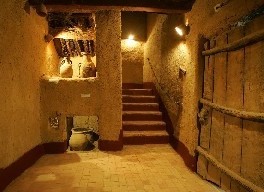
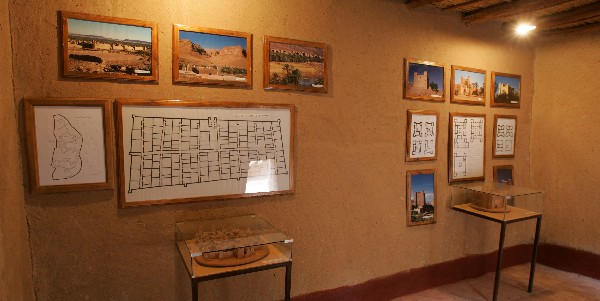
Opened in 2002, the Oasis Museum occupies a group of three restored houses inside the Ksar El Khorbat Oujdid, with a
total surface of 600 square meters, distributed over three levels.
See the plan of
the Oasis Museum
The posing is completely didactic, with the intension to
answer the questions visitor may have about the culture of the south of Morocco.
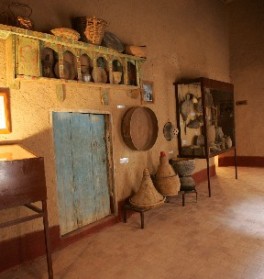
The Oasis Museum exposes:
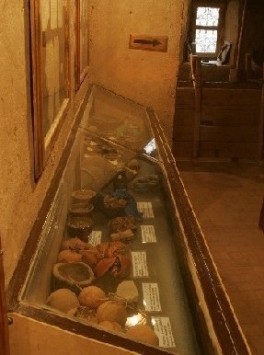
- 711 antiquities and objects of traditional use
- 49 explaining color photographs
- 33 historic photographs
- 17 maps and sketches
- 14 scale models and reproductions
- 6 topic maps
- 4 explaining paintings, painted by the local artist Rachid Bouskri
|

ATTENTION!

 |

 |
The Oasis Museum includes 22 halls, each one dedicated
to a special topic of the traditional live in oasis in the south of the High Atlas:
HALL 1:
Oasis: agriculture and
sedentary life
In
the presaharic area of South Morocco, agriculture and sedentary life are
limited to the middle of the valleys, where water from the Grat Atlas
Mountains or from the Jebel Saghro makes irrigation possible. These fertile
valleys are real oasis surrounded by arid land. Water comes to them from a
river or from subterranean springs by wells or from a Khettara.
|
 |
HALL 2:
Trade
In
addition to fertile valleys surrounded by arid land, oasis are also
commercial centers that provide the nearby areas with supplies via local
markets.
Formerly they were stages of the caravan routes that connected the cities in
North Morocco with sub-Sahara Africa. This last role has given them a great
economic prosperity throughout their history.
|

 |
HALL 3:
Handicraft
In
the oasis, handmade craft production tries to fill local needs and the
demand of the nomad population in the area. The iron work is a labor
undertaken specifically by the Black people. The silversmith’s work was long
ago a specialty of Hebrews. Carpentry and saddle making are both done by men
as a job.
Women weave carpets and blankets and embroider shawls, not in a professional
way but as a complementary activity along with the housework.
|

 |
HALLS 4, 5 & 6:
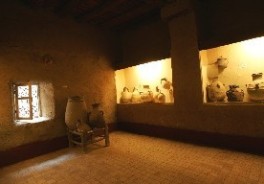
Pottery
In
presaharic valleys, pottery is a professional male activity, and several
villages are specialized in it.
It
is simple and useful pottery, without ornamental painting, but glazed
sometimes with natural enamel.
This enamel is composed of three minerals: quartz; a sandy clay, and lastly
lead sulfide if an ochre tone is desired or copper oxide for a green tone.
|
 |
HALL 7:
Tribal system
The connection between the members of one tribe is common ancestry, be it
real or legendary. On the other hand, they do not claim specific territory
for themselves, being able to live scattered over the four extremes of the
country and being able to share their villages with neighbors from other
tribes.
Each tribe is subdivided in many fractions, clans and families, always based
on blood ties. Different tribes can also come together to form a
confederation.
|

 |
HALL 8:
Dressing
Each tribe has its special mode of dress and ornamentation. Generally, men
dress in a wool or cotton gown, a jellaba or sometimes a cloak called
azennar or selham, complemented with a leather shepherd’s bag
and a dagger. Their head is not covered, just tied with a little black or
white turban.
Women wrap up with a shawl embroidered with the pictures of their tribe. It
has various names depending of the valley. This shawl covers their body and
often the head, sometimes even the face. If it doesn’t, a scarf is used as
well. They have several tattoos on their face, with show their tribal
membership. They always wear a lot of silver jewelry: armlets, necklaces,
fibules...
Nowadays, a part of the population wears European clothes, or dress the same
as in big Moroccan cities. Tattoos are disappearing and new jewels are made
of gold.
|

 |
HALL 9:
Celebrations
The most important parties are weddings. They can last one whole week and
many people take part in them. There are also other smaller familiar
celebrations, like births and circumcisions.
Each tribe has its own folklore, music and customs for the celebration, in
special the customs of the women, who in addition paint the face and they
put henna in the hands and the feet.
Another type of celebration is the moussem, around the tomb of a
dervish. They take place once in the year, with occasion of the Aid El Kebir
(commemoration of the Abraham’s sacrifice), of the Miloud (anniversary of
the birth of Mahomet) or at the end of the harvests. In them act the members
of a certain religious brotherhood. Usually they are accompanied by a great
market.
|

 |
HALL 10:
War
Over the centuries, wars were usual among tribes, between parts of the same
tribe, and with the nearby Ksars. Wars occurred for different reasons:
-
Irrigation water distribution.
-
Occupation of cultivatable lands.
-
Share of pasture lands.
-
To
get grain during hard times.
-
As
a revenge in personal matters.
|
 |
HALL 11:
Jewish cult
Some populations of Israelite origin has lived in the presaharic valleys for
over twenty centuries and has kept its religion through the years, in spite
of the conversion to Islam of the other inhabitants.
For the Jewish cult, there was a synagogue and a Hebrew cemetery in every
village where the Hebrews had their own neighborhood.
There, they did some specific activities: trade, money lending, silverwork
and other kinds of handicraft.
Almost all of the Jewish population immigrated to Israel in 1967 as a
consequence of the Six Days war.
|

 |
HALL 12:
Islamic cult
The practice of the Islamic cult implies the existence of a Mosque in each
village for prayers at noon on Friday (the remaining prayers may be said in
the Mosque or in any other place).
It
also implies the presence of a cemetery near the village, where the dead are
buried, wrapped up in a while cloth, without a coffin, and laid on their
right side to look at Mecca. Two stones on the grown show the position of
each grave.
Most of the cemeteries are placed under the symbolic protection of a shrine,
which provides a place to visit and pry. Being usually the Mosque just for
men, the shrine is attended mostly by women.
|
 |
HALLS 13 & 14:
The barn
The harvests of grains are stored in barns to keep them safe throughout the
year and to prevent someone from stealing them.
Inside Ksars, there is a little barn in each house. In
some villages which have no walls, a fortified community barn gives security
to the families who live there. Sometimes this building is placed under the
symbolic protection of a shrine.
Nomad tribes had also long ago hidden barns on top of some gullies in the
Great Atlas Mountains.
|
 |
HALL 15:
Food
In
the oasis, the base of diet is wheat, corn or barley flour. With it, the
women bake bread and make couscous.
This last one, cooked by steam, is the typical dinner in the region.
For lunch, bread is accompanied with vegetables and pieces of meat cooked in
an oil sauce with many spices added. In the north of the Atlas Mountains,
this mixture is prepared with a conic lid named tagine. Otherwise, in
presaharic valleys it was traditionally cooked with clay pots, which have
been substituted nowadays for aluminum pressure cookers.
For breakfast, people eat bread with oil and drink tea. Other kinds of
breakfast are the barley soup and the bread stuffed with grease.
|
 |
HALL 16:
Traditional medicine
Many natural products are used to heal different illnesses, and also for
good luck in business or in love.
Between them, we have to mention henna: an herb cultivated in presaharic
valleys and exported all over Morocco. It is applied sometimes on wounds and
skin illnesses and it is also used by women to dye the palms of their hands,
their feet or their hair, with an esthetic objective and for good luck.
Henna pictures with geometric patterns are very popular in the big cities of
Morocco, but not in this area.
|

 |
HALLS 17, 18 & 19:
Soil architecture
All traditional housing of presaharic valleys is build using soil in two
different ways:
-
Pisé (rammed earth) for the master walls.
-
Sun-dried clay bricks for the internal walls, the arches, columns and
decoration.
The external finish is a mixture of mud and straw. The ceilings may be built
with palm tree trunks, canes, tuia branches or oleander stems, sometimes
placed in order to form an ornamental design.
These ceilings are supported on rafters made from palm trees, black poplar
or tamarind, and they are covered also with earth.
|

 |
HALL 20:
Kasbahs and Ksars
All the traditional architecture of presaharic valleys is based on the
principal of fortification.
-
The Kasbah is a building with several floors and watchtowers at the four
corners and sometimes –not always- a central courtyard. Kasbahs are usually
isolated, but one can also find them inside a Ksar.
-
The Ksar is a village surrounded by walls with some watchtowers at different
points and one or several huge entrances. Inside there are houses, a mosque,
a place for celebrations and sometimes an inn.
Nowadays, both are being gradually substituted by new dwellings made of
reinforced concrete.
|
 |
HALL 21:
The watchtower
Inside Ksars, each watchtower (except the two in the entrance) belongs to an
inhabitant, who in ancient times was responsible for controlling its
surroundings and, in case of armed conflict, defending his part of the wall.
After peace came to the presaharic valleys, these towers became little
sitting rooms where guests are received.
|
 |
HALL 22:
Nomad life
While cattle raising takes place inside the Ksars, sheep, dromedaries and
goats require a constant search for new pastures. In order to shepherd the
herds, a part of the population practices nomad life. They live in tents and
carry all their belongings with them.
Due to such a hard life, these shepherds are much stronger, more resistant
and braver than the sedentary farmers. For this reason, in ancient times
there was a relationship of dependence between the nomad protectors and
their counterparts who farmed in the oasis. |
|
The Oasis Museum is the first and unique establishment with these
characteristics in the South of Morocco.
- Opening hours: from 9,00 AM to 9,00 PM. The key is available at the restaurant.
- Entrance fee: 20 DH
per person. Children under 12 years go for free.
|

|
|
|