|
The word Ksar has a wide meaning. It can refer to any kind
of fortress, palace, barn or military base, depending on the country and the region where it’s located.
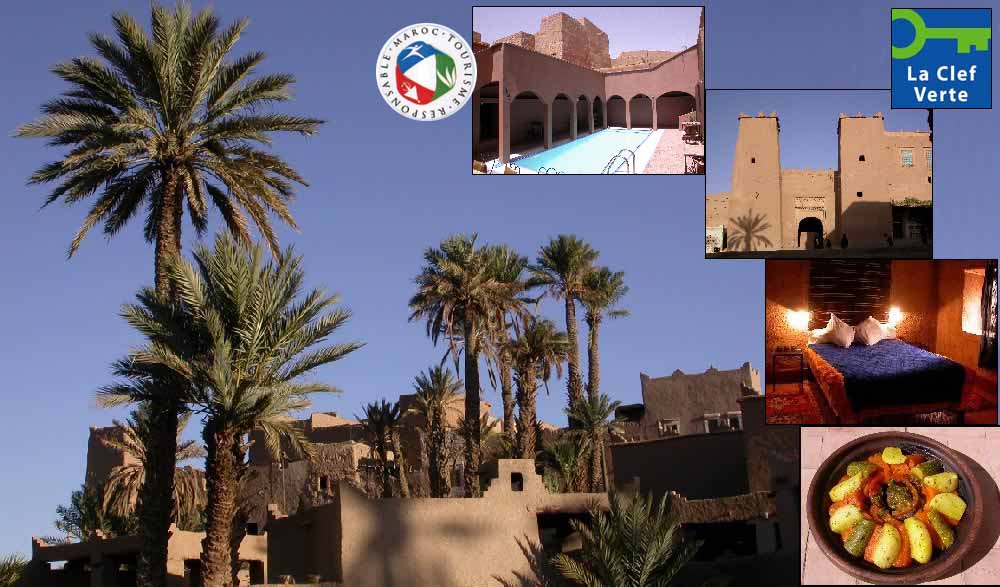
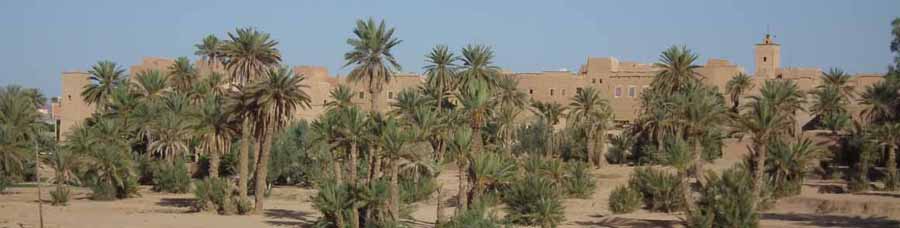
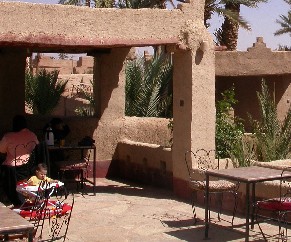
In the south of Morocco, a Ksar is a village surrounded by
walls, made of soil, with one or more monumental entrances and at least the following communitarian infrastructure: the mosque,
the baths, a Koran school, a public place and sometimes an inn.
In the pre-Saharan valleys, between the rivers Drâa and Ziz, there
were about one thousand Ksars in 1920. Today, more than half of them have disappeared or are in ruins, but still
there are some that a partly or completely inhabited. They form a very important historic and artistic patrimony that
hasn’t been protected until the last years of the 20th century.
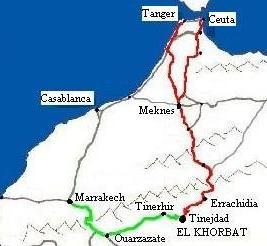
The name El Khorbat (which in Arab means
‟the ruins”) makes us think that its founders were Beni Maaquil Arabs of Roha tribe who settled in the region of Ferkla
in the 14th or 15th century. A part of the population also consists of farmers with dark skin known as Ikabliin.
At the beginning of the 19th century, the old Ksar El Khorbat
(Ighrem Akedim) was occupied by the Ait Atta Berbers, who chased away the Arabs but accepted to live together with the Ikabliin in
order to keep them cultivating the land recently occupied. Later on they extended the village and constructed a new wall.
At about 1860 another Berber tribe, the Ait Merghad that
came originally from the valley of Dadès, chased away the Ait Atta from El Khorbat and built a second Ksar next to it called Oujdid,
which became their political capital. The Kaid or chief of the tribe had his residence in El Khorbat and was recognized by the
Sultan of Morocco.
The important political role of El Khorbat was maintained until the
beginning of the French protectorate in 1934. After this date, the French authorities constructed their ‟Bureau d’Affaires
Indigènes” about five kilometres further in the east, in order to be the future town of Tinejdad, and they transferred the
administration of the oasis over there.
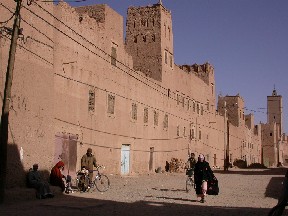
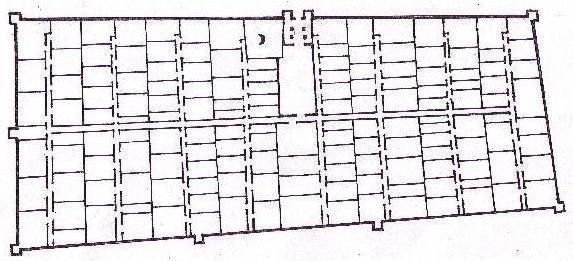
The Ksar El Khorbat Oujdid was constructed following a rectangular
and very regular sketch. It is crossed by a central street from one end to the other. The doors of the houses are
distributed over eight impasses perpendicular to the main street. The only exception is the Kaid’s house which opens directly
to this one.
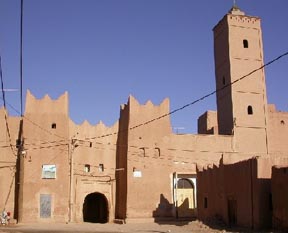
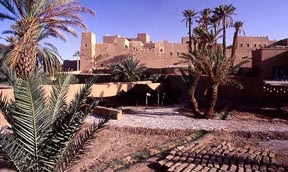
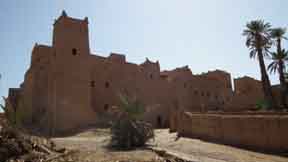
At the beginning there was only one monumental entrance
into the Ksar. This entrance has the shape of an arch and simple decorations. There are also two watchtowers at the two sides
of the entrance, four in the corners, one on the lateral side, and two on the backside, in total nine watchtowers. The public place
with the mosque is located between the entrance and the central street.
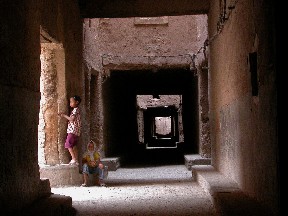
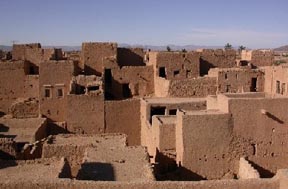
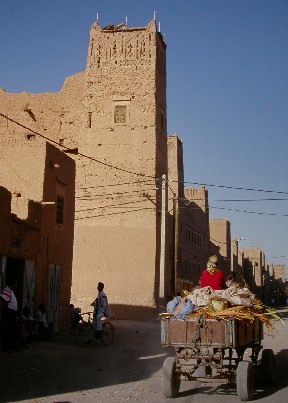
The main and the side streets are mostly shaded by the first floors of the
houses. Only the crossings are not; so they appear like fountains of light and give the whole Ksar a mysterious attractively.
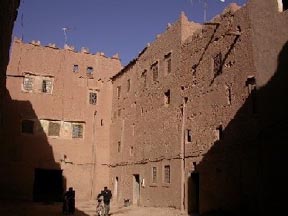
The houses have three to four levels, which mean 10
to 14 meters height. The surface is varying between 30 and 200 square meters in each floor. The ground level, the first floor and
sometimes as well the second floor are constructed with pisé (rammed earth). The third floor is built with
sun-dried clay bricks, with a thickness of about 30 cm. The outer wall reaches 100 cm. of thickness and a heigh of
four meters and continues with 50 cm. thickness for 9 to 12 meters. Many houses are connected with the wall.
The traditional doors are made with palm tree wood.
Some windows are also made of wood, but others have forged iron grills. The exterior decoration occupies the
highest part of the buildings. It consists of geometric figures made with clay bricks. The parapets that surround the terraces are
crowned by triangular step like battlements.
Recently there have been opened new entrances to the houses piercing the
outer wall an some of them have iron doors. There also has been constructed a minaret of concrete above the mosque, but it has been
recovered with clay and straw in order to make appear visually similar to the rest of the village.
The Ksar El Khorbat has been restored by a local Association,
thanks to the financial help of the School of technical Architects of Barcelona.
Ksar El Khorbat, Morocco
Phone 00-212-535880355 Fax 00-212-535880357
Mobile 00-212-676527392

|